



These words belonged to a work of fiction. But the moment they fell from the lips of Morgan Freeman, not as a screen character, but as the human being who carries that voice, they took on an altogether different weight. For Freeman’s life, much like the Red he portrayed, is a journey in which hope is both dangerous and indispensable: delayed justice, long waiting, and ultimately a quiet victory.
CEM BAHADIR
”Hope is a good thing, maybe the best of things. And no good thing ever dies”.
Andy Dufresne, The Shawshank Redemption (1994)
These words belong to a work of fiction.
But the moment they fell from the lips not of a screen character but of Morgan Freeman, the human being who carries that voice, they took on an altogether different weight. For Freeman’s life, much like the character of Red he portrayed, was a journey in which hope was both dangerous and indispensable: a journey of delayed justice, long waiting, and ultimately a quiet victory.
To understand where that voice comes from, one must return to Memphis. Everything begins there: poverty, uprootedness, deferred dreams, and the silent germination of one of the world’s most recognised voices.
That Long Road Beginning in Memphis
He was born on 1 June 1937 in Memphis, Tennessee, the youngest of five siblings. His father, Morgan Freeman, was a barber; his mother, Mayme Edna, a teacher. The family’s finances meant that home was always changing. Young Morgan lived for a time with his grandmother in Mississippi. His grandmother’s death became less a symbol of bereavement than of growing up estranged from himself. Chicago, then back south, then north again; each migration, each city, taught him something: people leave, but voices remain.
He was shy at school; but when the stage appeared, he became someone else. In his middle school years, he won the entire state’s Dramatic Reading Competition. The applause he received that day was the first echo of a voice that would never fall silent. Yet the young Morgan, in that moment, did not want to be an actor. He wanted to be a pilot.
When he graduated from high school in 1955, he turned down the Drama department scholarship and enlisted in the United States Air Force. For four years he lived in the shadow of aircraft. But he never earned his pilot’s wings. Unarmed defence, administrative duties, hours spent under the orders of controllers…
Was this failure, or the closing of a door? Freeman would say years later: ”While I was in military service, I sat in the cockpit seat of a jet aircraft. And a voice inside me said, ‘This is not your place.’ Perhaps I already knew”.
When he left the army in 1959, he had his freedom in hand. And he took that freedom to New York.
New York, but at What Price?
New York in the 1960s was both an opportunity and a living letter of rejection. He took dance lessons in Harlem, knocked on office doors, did odd jobs. Acting auditions by night, secretarial work and data entry by day. Life was trying to wear him down quickly. He was refusing to be worn down quickly.
In 1967 he took his first step onto a Broadway stage. Then, for years, he performed in the city’s small off-Broadway theatres, in municipally funded productions, in children’s education programmes. His refinement came from there: he learned the stage, learned to meet the audience eye to eye, learned to be silent. Just as Red says:
”I’ve watched people come and go here for years. They had titles, they had money, they had nerve. But they never understood these walls. I did. I understood what time means”.
(Red, The Shawshank Redemption)
In 1978 he won the Drama Desk Award for his performance in The Mighty Gents and received a Tony nomination. Beneath characters written in street vernacular lay a Shakespearean wisdom. The audience felt it but could not name it. Freeman’s peers from that period had long since become stars. He was still being forged on stage.
Hollywood’s Long Silence, and the Birth of a Name
Hollywood discovered him late; but once it did, it could not let go. His dangerous and slippery role in the 1987 film Street Smart drew the attention of Pauline Kael, one of the era’s sharpest critics, and prompted her to ask: ”Is this the greatest actor in America?” The film also earned Freeman his first Oscar nomination.
Two years later, in 1989, the role of Hoke Colburn in Driving Miss Daisy was something singular: the story of a man whose allegiances were never entirely clear, and of how an inevitable closeness transforms him over the years. Freeman brought a magnificent stillness to the character; Hoke never spoke too much, never collapsed unnecessarily. His dignity filled the scenes. The Oscar remained distant this time too. But Freeman, at that stage of his life, had already learned how to wait.
Shawshank: Living Hope Within Walls
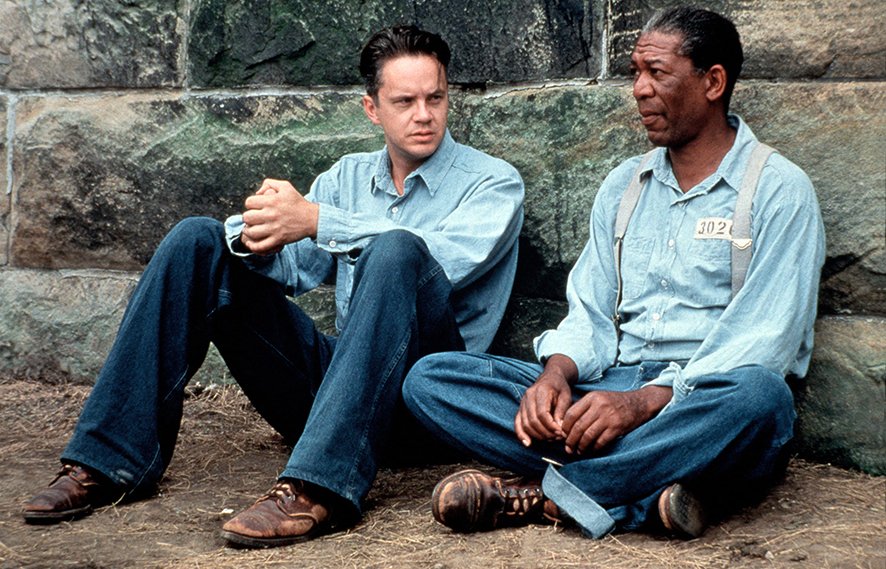
In 1994, he stepped before Frank Darabont’s camera and became Ellis Boyd “Red” Redding. The screenplay, adapted from Stephen King’s novella, which King himself has said is his favourite story despite all literary criticism, would become the turning point of Freeman’s career. But no one knew it at the time.
The film had failed to hold at the box office. It could not find a drama audience in cinemas and Shawshank closed with a modest 16 million dollars. But the critics noticed. And then a movement began in the video rental shelves: cassettes passed from hand to hand, shown to friends and family, found in prisons and in the living rooms of people who had known hard nights. In time, the film rose to the top of IMDb’s highest-rated films list and remained there for years.
Who Is Red?
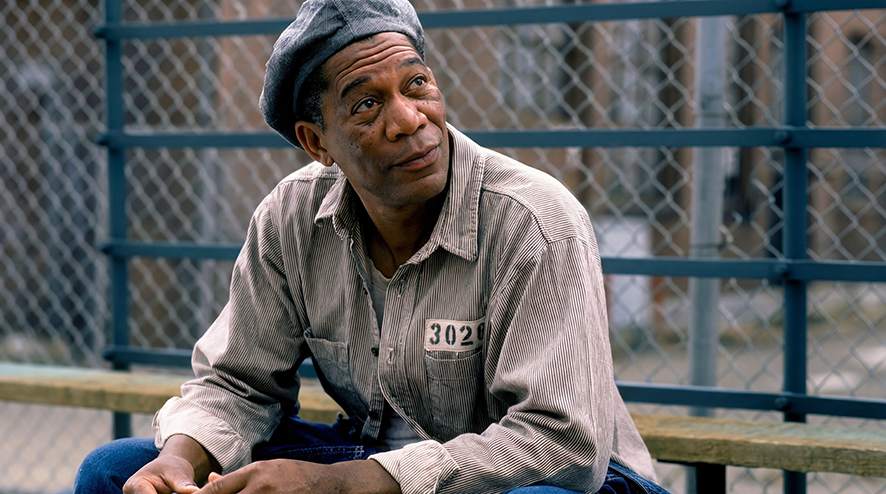
Red was a man of Shawshank Prison, someone who could do nothing on the outside but managed everything on the inside. For years he had appeared before the parole board; each time rejected, each time returning. One must consider how Freeman played those scenes: no anger, no protest, no shame. Only a worn openness. As though dreams had stopped collapsing and the men had begun learning to collapse all over again.
Red’s assessment upon first seeing Andy Dufresne was one of the film’s sharpest lines:
”When I first saw that man, I thought: he won’t make it. I can read the state of inmates serving life. But I was wrong about him. There was something in Andy Dufresne that was beyond us. By the time I understood that, it was too late, not for him, for me”.
(Red, The Shawshank Redemption)
When Freeman read these lines, screenplay in hand, what did he think? The man who spent thirty years going to acting auditions, who turned down a Drama scholarship and enlisted in the army, who walked toward hunger in New York, was he now finding in Red’s lines a reflection of his own biography? Whether he gave that answer or not, no one knows. But the wisdom he carried while playing Red was so profound that it could not have belonged to a written character alone.
The Hope Debate: Dangerous or Necessary?
In one of the film’s most important scenes, Andy speaks to Red about hope; Red resists:
”Hope is a dangerous thing, Andy. Hope can drive a man insane”.
(Red, The Shawshank Redemption)
This sentence establishes the film’s philosophical axis. Freeman plays it not as a plain warning but as a call for protection arising from deep pain. Red has watched people be destroyed by their dreams. Perhaps he has lived it himself. Hope has cost him dearly. But faced with Andy’s strange, insistent optimism, Red too slowly unravels. He learns that resisting hope also carries a price.
In the scene where, after his long prison years, Andy channels music through the walls, Red narrates:
”I have no idea to this day what those two Italian ladies were singing about. Truth is, I don’t want to know. Some things are best left unsaid. I’d like to think they were singing about something so beautiful it can’t be expressed in words, and it makes your heart ache because of it. I tell you, those voices soared higher and farther than anybody in a grey place dares to dream. It was like some beautiful bird flapped into our drab little cage and made these walls dissolve away. And for the briefest of moments, every last man at Shawshank felt free”.
(Red, The Shawshank Redemption)
Freeman delivers this monologue with his eyelids narrowed and his face tilted gently toward his chest. His voice descends, almost to a whisper, as though he knows the physical weight of the words he is about to use. Red gives everyone who hears this narration the gift of that moment. And Freeman’s voice is the paper in which that gift is wrapped.
The Summary of Forty Years: A Single Sentence
Red’s classic response at his parole hearings carries both a thought-provoking and a trembling silence:
”Rehabilitated? Well, now, let me see. You know, I don’t have any idea what that means. I know what you think it means, sonny. To me, it’s just a made-up word. A politician’s word, so that young fellas like yourself can wear a suit and a tie and have a job. What do I really want to say to you? I’m telling you that every last man in this room, and every man I’ve met in my years here, is sorry for what he did. Or not sorry enough”.
(Red, The Shawshank Redemption)
This scene is one of Freeman’s most affecting performances: beneath everything he says lies a life weighed with meaning, unspoken. Exhaustion, remorse, and a strange resonance. Freeman calls on no external dramatic gesture for this scene: he sits upright, his eyes do not fill, his voice does not waver. The weight of what he carries inside reaches the audience without assistance.
That Final Monologue
The film’s final scene is one of cinema history’s most powerful closings. Red, freed after long years, writes in his journal:
”I find I’m so excited I can barely sit still or hold a thought in my head. I think it’s the excitement only a free man can feel, a free man at the start of a long journey whose conclusion is uncertain. I hope I can make it across the border. I hope to see my friend and shake his hand. I hope the Pacific is as blue as it has been in my dreams. I hope”.
(Red, The Shawshank Redemption)
Freeman delivers this monologue as a voice from behind the screen. Even after the screen has gone dark, that voice remains suspended in the auditorium.
”I hope”.
A single word. And Freeman says it in such a way that whatever the listener feels about that moment, they live it all at once: loneliness, fear, embrace. A door is about to open. And the voice that opens it with you is the distilled essence of decades of waiting.
It is not so difficult to understand why that voice is this consoling: because its owner has earned it. The depth of Freeman’s voice comes not from age but from having carried that age with conscious patience. Just as Red, after forty years in prison, can still hope.
The Oscar Knocked on the Door at the Seventeenth Attempt
After Shawshank, Freeman’s filmography began displaying different faces of a consistent character. Detective Somerset in Se7en (1995), a man who had washed up at the shore of exhaustion but had still not abandoned doing what he believed right, was another layer of the archetype Freeman had constructed.
Finally, in 2004, his role as retired boxer Scrap-Iron Eddie Dupris in Clint Eastwood’s Million Dollar Baby opened the Academy’s door: Best Supporting Actor. As he walked to the stage, his face held neither exhilaration nor relief, only that familiar, deep composure. As though he already knew, and had been waiting.
Before and after: Nelson Mandela in Invictus, as though this role too had spent years waiting for Freeman, for both men knew the depth of a waiting exceeding thirty years, carried it silently, and ultimately spoke; the wise Lucius Fox in the Batman trilogy; and in The Bucket List, the late-ripening bond of two men rediscovering each other on the threshold of death alongside Jack Nicholson.
In every film, the same thing was present: weight. The weight of being present on screen. Freeman’s acting philosophy had over the years summarised itself in a narrow frame: ”I just listen. I truly look at the person across from me. The rest comes by itself”.
Quietly Doing Good Off Screen
He founded a blues club in Mississippi: Ground Zero Blues Club. In Clarksdale, on the land where blues was born, in a crumbling building in a used-up and abandoned town. Every evening that venue rings out; every evening it cries the universal sorrow of the human being. Freeman did not build it merely to make money; he built it to construct a deep-rooted memory.
Through the Tallahatchie River Foundation he donated to impoverished schools in Mississippi, supported education. He returned to the soil where he grew up, to the children left behind there, but quietly. Without press conferences, without stepping before cameras. The Kennedy Center Honor (2008) and the SAG Lifetime Achievement Award seemed, somehow, the outward reflection back from the world of what he embodied.
Freeman once said: ”Stories have to be told. There is no other way to bring out what’s inside us. That’s what we actors are here for”.
The Anatomy of His Voice: Why Is It This Consoling?
Cinema lovers who over the years tried to describe Morgan Freeman’s voice had found one word: gravitas. This Latin word, meaning “weight”, has permeated Freeman’s body language, his gaze, and above all his voice. To understand where this gravitas comes from was the real subject of writing a biography.
Were we to make a Freudian reading, we might say it is the bodily memory of a childhood exile, a child who moved from house to house, forced to take root anew in every place. Or it was the accumulation carried for years inside the man who returned from the army empty-handed, the actor who waited at the edges of stages, the artist recognised too late. But it would be more correct to ask Freeman himself; and over the years he had said: ”Don’t externalise. Try to keep everything inside. Then the audience finds it”.
This was also the summary of Red’s own philosophy. When Red learns that Andy has escaped from his cell and reached freedom, he is shaken at first. Then he writes these lines:
”I find I’m so excited I can barely sit still or hold a thought in my head. I think it’s the excitement only a free man can feel, a free man at the start of a long journey whose conclusion is uncertain. I hope”.
(Red, The Shawshank Redemption)
And Freeman says ”I hope”. Just three syllables. But even after the screen has gone dark, those three syllables remain suspended in the auditorium. What makes this possible is that Freeman has truly lived those words.
At Eighty-Eight, Still on That Long Road
Morgan Freeman is currently 88 years old. His hand, from an accident suffered years ago, does not grip fully; his left arm hangs slack. But that bewitching, magical voice of his remains one of the most recognised voices in the world.
Shawshank’s famous line has lodged itself in our memory: ”Get busy living, or get busy dying”.
It summarises Freeman’s biography.
The world waited to prepare itself to deserve his voice.
Red’s final word was, in truth, his own.
Both spoke it with the patience of a lifetime: ”I hope”.