



THE MAN WHO CARRIED THE SOIL OF SEVERAL CONTINENTS IN HIS SPIRIT
CEM BAHADIR
The year was 1915. The cloud of dust and blood from the Mexican Revolution had not yet settled; the soil of Chihuahua groaned beneath the hooves of Pancho Villa’s guerrilla horses. In the heart of this chaos, the world’s most unlikely actor was born: Manuel Antonio Rodolfo Quinn Oaxaca. Born to an Irish-Mexican father and a Mexican mother. The child of two countries, two bloodlines, two cultures. Yet neither Mexico nor Ireland would give him his true identity; the version of him that would shape his future was not yet born. That identity, years later, he would find himself, dancing along the dusty roads of Crete.
His family moved to Los Angeles in the wake of the revolution. His father found work as a camera assistant at a studio, where young Manuel came to know names like Tom Mix and John Barrymore in the corridors of that studio, walking alongside his father. But life was not easy; he worked in butcher shops, at slaughterhouses, in boxing rings. He became a speaker for an evangelical movement, preaching on street corners. He won an architecture scholarship with Frank Lloyd Wright, but in the end, he chose the theatre. The stage seized him more deeply than any other calling; on stage, he did not have to be a Mexican—he could be anyone. Hollywood opened its doors to him, and as he walked in, he carried not his ethnic identity, but his humanity.
In 1977, the film was about to open in America. On that day, the Hanafi movement, a Black nationalist group, stormed the B’nai B’rith building in Washington D.C., took hostages, and killed two people. Their stated reason was astonishing: a mistaken belief that Anthony Quinn had portrayed the Prophet Muhammad in the film.
He shot his first film in 1936. Dozens of roles followed; but most were typecast ‘foreigner’ figures, Native American, Arab, Spanish, Mexican. Hollywood’s stereotype factory tried to press him into a mould. He waited to blow that mould apart from within; patiently, stubbornly.
In Viva Zapata! (1952), he played Eufemio, brother of Emiliano Zapata, and won his first Oscar. It was noted in history that he was the first actor of Mexican descent to receive the award. Four years later, in Vincent Minnelli’s Paul Gauguin biopic Lust for Life (1956), he portrayed Gauguin opposite Kirk Douglas and took home his second Oscar. Two different films, two opposite extremes, one a Mexican revolutionary, the other a French Impressionist painter, yet in both, the same Quinn was present: raw, real, and no less complex. Earlier, in 1954, Fellini cast him in La Strada as Zampanò, a brutish circus performer. Alongside Giulietta Masina, he delivered a minimal yet crushing performance. La Strada was the symbol of Quinn’s encounter with world cinema. He was no longer merely a Hollywood actor, he had become the universal interpreter of the human condition.
Zorba
1964. Michael Cacoyannis was looking for an actor to bring Nikos Kazantzakis’s 1946 novel, Zorba the Greek, to the screen. The man he needed was Zorba, but Zorba was not a character; he was a force. Raw as earth, overflowing as the sea, intoxicating as wine. Many names were considered. But those who had read Kazantzakis’s Zorba found only one man in their minds. Anthony Quinn.
The film was adapted from Kazantzakis’s novel: a young Englishman named Basil travels to Crete to operate a mine and chances upon Zorba. Zorba is an old, rough Greek who has gnawed and swallowed every corner of life. The two men are entirely unlike each other, one lives inside books, the other lives only inside life. And this contrast fuels the entire energy of the film.
In Cacoyannis’s lens, Crete was not merely a setting. That barren plain, that coastline, that aged Greek village, all were externalizations of Zorba’s soul. Mikis Theodorakis’s music illuminated the film from within: that sirtaki melody, upon first hearing, was assumed to be a traditional Greek folk tune; yet Theodorakis had composed it specifically for the film. When Quinn heard that music, something happened inside him.
Quinn did not teach himself the sirtaki. Quinn made the sirtaki his own, and Theodorakis wrote the music.
The film’s final scene became one of the most unforgettable moments in cinema history. Everything had collapsed: the platform they had built had caved in, the money was gone, the plans had come to nothing. And at that very moment of ruin, Basil asks Zorba: “Teach me to dance”. Zorba laughs, with that particular, thunderous, deep laugh of his, and on the sandy shore, before the broken wooden wreckage, before the Aegean, he begins to stamp his feet upon the ground.
“A man needs a little madness, or else, he never dares cut the rope and be free”.
In that scene, Quinn did not dance, Quinn existed. Bosley Crowther, reviewing the film in The New York Times, called it ‘a brilliant performance.’ But critics and audiences alike felt the same thing: it was impossible to separate Quinn from Zorba, or Zorba from Quinn. This was one of cinema’s rarest miracles, an actor so fused with his role that the role became biography.
The film received seven Oscar nominations. Lila Kedrova won Best Supporting Actress; the film also took Best Cinematography and Best Art Direction. Quinn received a Best Actor nomination for Zorba but did not win — it was his fourth and final Oscar nomination. Whether he won or not hardly mattered anymore; the world had accepted Zorba as Quinn.
For the rest of his life, people would call him Zorba. In interviews, on the streets, on stage. Quinn sometimes found that burden heavy, but he never refused it. Because he had understood Zorba’s spirit: to accept life’s pain, and to live its beauty with one’s entire body. In 1983, he revived the same character on Broadway as a musical, for 362 performances. Lila Kedrova was at his side again. All of New York could see that Zorba had not died, he had gone on living inside Quinn’s body.
The Message
It was 1962. A young Syrian named Moustapha Akkad watched David Lean’s Lawrence of Arabia at a cinema in Los Angeles. As Omar Sharif emerged like a ghost from the desert, something stirred within Akkad. He saw that an Arab face, an Arab story, a saga told through a Muslim’s eyes, could find its place on the big screen. And from that day forward, he lived with a single dream: to bring the life of the Prophet Muhammad to cinema.
Preparation took more than a decade. Akkad received script approval from Islamic scholars in Cairo. He secured financing from Gulf states and Libya. But the greatest challenge was clear: the Prophet could not be shown on screen. Islamic tradition forbade the depiction of the Prophet’s image. Would this prohibition make the film impossible? Akkad said no. He shifted the camera’s focus: the Prophet’s uncle, Hamza, would be the heart of the film.
When Akkad brought the first offer to Quinn, he opened the door for every other actor.
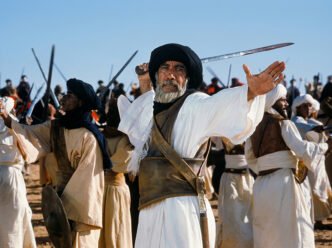
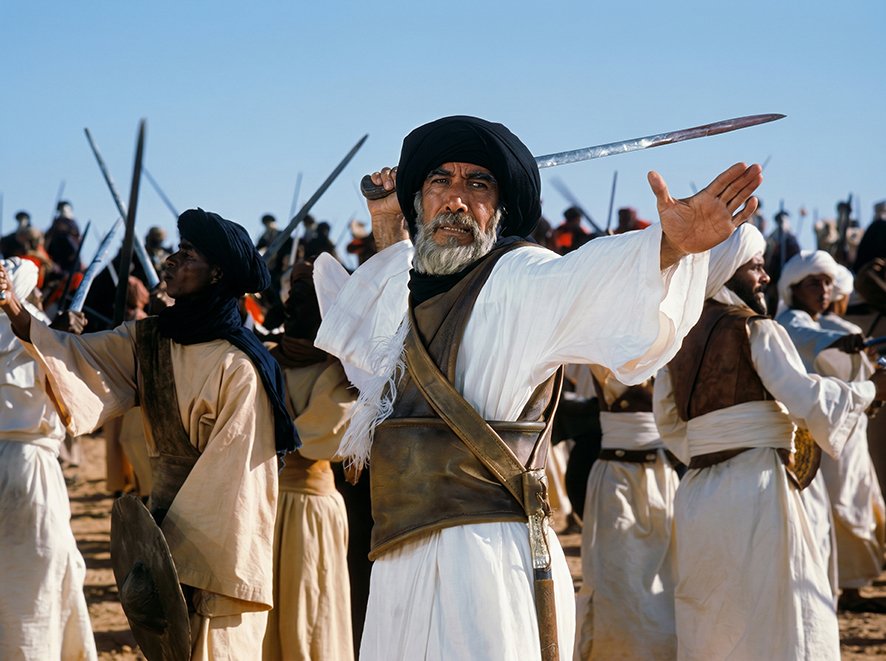
Moustapha Akkad needed an international star to bring his project to life, a name that would open doors for hesitant actors and prove the film’s seriousness to the world. And Akkad went to Quinn. He told a Mexican-Irish actor that he would portray the brave uncle of the Prophet Muhammad. Quinn accepted, and that acceptance changed the fate of the film. The other actors were persuaded; filming began.
The budget was 17 million dollars, resources gathered from Kuwait, Libya, Morocco, Saudi Arabia, and the United States. An international co-production spanning Morocco, Syria, and England. The 700,000-dollar Mecca set constructed in Morocco was one of the largest film infrastructures of its era. Akkad shot the film in two separate versions, English and Arabic, using different casts for each. Where Quinn played Hamza in the English version, Abdullah Gaith took the stage in the Arabic version.
The filming process was an unrelenting chain of crises. Shooting began in Morocco; but King Hassan II, under pressure from Saudi Arabia’s King Faisal, was forced to halt the production. Akkad met with Gaddafi and screened the raw footage for him. Gaddafi gave his support; filming moved to Libya. When Gaddafi saw the crew suffering in the sweltering desert heat, he sent private air conditioners to the set.
Quinn found something in that desert. Playing Hamza in the English version, he felt the weight of the character. Hamza, the Prophet’s uncle, one of Mecca’s mightiest warriors, multiplied the courage of those who embraced Islam. And in the film’s narrative, Hamza beat like the unseen Prophet’s heart; in every scene that followed the Prophet’s path, Hamza’s eyes, hands, and footsteps did the speaking.
“Quinn’s dignity and gravity in the film was precisely what the role demanded,”–Charles Champlin, Los Angeles Times.
Before the film opened, a hostage crisis erupted in Washington, caused by a misunderstanding about Quinn.
In 1977, the film was about to open in America. On that day, the Hanafi movement, a Black nationalist group, stormed the B’nai B’rith building in Washington D.C., took hostages, and killed two people. Their stated reason was astonishing: a mistaken belief that Anthony Quinn had portrayed the Prophet Muhammad in the film. Yet in the film, the Prophet neither appeared nor spoke; he was only implied. Akkad offered to negotiate with the group and told them that if they found the film offensive, he would destroy it. The film was pulled from theatres; the crisis ended three days later and the film resumed its run.
This tragic misunderstanding encapsulated the paradox the film carried: a film attempting to build a bridge across one of the world’s greatest crises of understanding, between the West and the Islamic world, was nearly burned down by a crisis while trying to build that very bridge.
Akkad said he could never understand this contradiction; how could he, when the film had been made precisely to mend the divide?
The film was banned in Egypt, Kuwait, and Saudi Arabia. Cairene scholars, despite having previously approved the screenplay, declared the completed film ‘an insult to Islam.’ But in time, the film’s way was cleared. More than forty years later, in 2018, a 4K restoration was released in cinemas across the Middle East and North Africa. Akkad’s son Malek described his father’s favourite scene: the scene in which the Prophet’s followers are tested before the Christian King of Abyssinia, the Negus. There, a character speaks:
“Muhammad teaches us to worship one God. To speak the truth. To love our neighbour as ourselves”.
In that scene, Akkad was declaring what the true bridge between civilisations was. He himself was killed in an Al-Qaeda bombing in Amman in 2005; his daughter Rima died in the same blast. The man who dreamed of building bridges was taken by the hands of those who destroy them.
Anthony Quinn portrayed more than a hundred characters over his career: American, Arab, Greek, Mexican, Chinese, Mongolian, French, Palestinian, Hawaiian, Italian, Irish, and many more. But this geographic and ethnic multiplicity was also his tragedy. Hollywood used him as an ‘ethnic type’ and each time, he overflowed the mould and reshaped it.
An Actor’s True Identity
His life was no different from his roles: three marriages, thirteen children, the last born when he was eighty-one, in the corner of his final years. He sculpted; he painted. He held exhibitions in Vienna, Paris, and Seoul. He spent time with paints and clay on the shores of Bristol, Rhode Island. The Zorba within him kept on dancing long after the studios closed.
Even in death, he spoke several languages, carrying the soil of several continents in his body.
On 3 June 2001 in Boston, at the age of eighty-six, he died of pneumonia and respiratory failure related to throat cancer. But before he died, in his final years, he had answered a question he was often asked: ‘Which of your roles did you love the most?’ Zorba, always Zorba, he said. But an inner voice, perhaps, also whispered Hamza, and perhaps Zampanò from La Strada.
Quinn’s legacy was the victory he won against an industry that tried to confine him to a stereotype. On the road from a poor Mexican child to Hollywood’s greatest character, he asked a question in every role: What is a human being? Where is he from? Which soil belongs to him? And each time he gave the same answer: Wherever they are from, whoever they are, a human being finds their true identity when they learn to live. That is why Zorba danced. That is why Hamza fought.
On the shore of Crete, before the wreckage, as he stamped his feet upon the sand, Quinn knew one thing: for a human being, the greatest defeat is to weep. The greatest victory is to dance, after everything has been lost.
“He was a man who bore the full weight of the human condition, both primitive and wise, both savage and tender,’’ – Critic, Cleveland Plain Dealer, 1964.