



On John Steinbeck’s Of Mice and Men
SEBAHATTİN ÇELEBİ
There are stories that, while you read them, make you feel something closing inside you. Not a door, something deeper. Perhaps a season. Perhaps a belief. John Steinbeck’s Of Mice and Men, written in 1937, was one such story. A slender book, with few pages; yet the weight it carried was the weight of a century’s sorrow. What it left behind in the reader was not literary knowledge, but a heavy reckoning with one’s own nature.
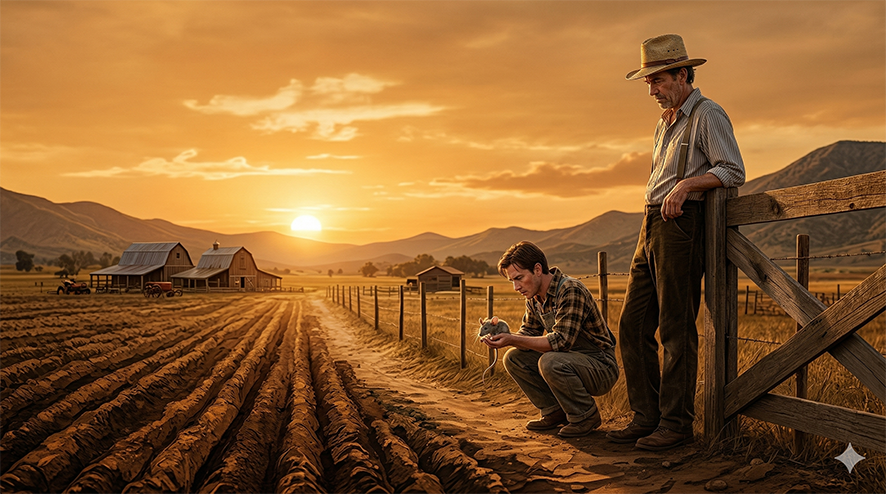
Steinbeck had deposited his heroes in the sun-scorched plains of California, at the height of the Great Depression. There, between dust and exhaustion, two men walked: George Milton and Lennie Small. One carried the other; and the other, unknowingly, one after another, consumed everything his hands came to touch. The story of these two men had long since outgrown the confines of a novel; it had become an image of humanity’s shared grief.
Steinbeck made his first steps in the literary world by working side by side with the poor. John Ernst Steinbeck was born in 1902 in Salinas, California, although it was a fertile agricultural region. This fertility belonged not to the seasonal labourers who worked the land, but to the large landowners who stood above them. Steinbeck did not perceive this inequality as a distant social phenomenon; he lived it. In his youth he worked on farms as a labourer, slept in grain warehouses, endured the arbitrary authority of estate owners, and in that process, he gained the most precious thing a writer can possess: he learned the truth not from written books, but from the smell of the earth.
Steinbeck’s convictions did not fit within the frame of any conventional religion. He kept his distance from the Church, from dogma. Yet this did not mean he was a man without a spiritual world. On the contrary, a deep and almost devotional reverence for the human being coursed beneath the surface of all his work. The figure who most shaped this sensibility was his friend, the biologist Ed Ricketts, who introduced Steinbeck to what he called “non-teleological thinking”, the practice of asking not why something happens, but how it happens. This approach was reflected in his characters: in his novels there were no guilty parties, only circumstances. Lennie did not intend to cause harm; George was not a bad man. It simply was. This perspective made Steinbeck simultaneously one of the most unflinching and most compassionate writers of his age.
A writer of left-leaning politics, Steinbeck regarded the defence of the labouring class’s dignity as a duty. This position made him a target in conservative circles; his books were banned, burned, condemned. But Steinbeck did not chase popular approval. When he was awarded the Nobel Prize in Literature in 1962, the Swedish Academy described his work as the product of a “realistic and imaginative” vision. Those two words, realistic and imaginative, described Steinbeck precisely.
The novel was born out of a poem and drawn from a real man. Before beginning it, before beginning the novel, Steinbeck searched for a title. He found it in a poem by the Scottish poet Robert Burns, written in 1785: “To a Mouse”. While plowing his field, Burns had accidentally destroyed a mouse’s nest. The famous lines read: “The best-laid schemes o’ mice an’ men / Gang aft agley”. Steinbeck found in those words the entire soul of his novel—for that was precisely what he was telling: the story of those who dream so much, yet never arrive”. Lennie Small, meanwhile, was drawn from a real person. During the years Steinbeck spent working on farms, he knew a burly, mentally disabled labourer who one day killed a ranch foreman—not in sudden rage, but as a victim of his own uncontrollable strength.
Steinbeck had carried this man in his mind for many years. He did not see him as a monster, but as a tragedy. Lennie was that stored memory transformed into literature.
Before the novel was first published, Steinbeck had envisioned a different title: “Something That Happened”. A title he later abandoned, yet the meaning it bore is profound. He regarded the novel not as a document of accusation, but of observation alone. It happened. It happened this way. And bearing responsibility for it was perhaps a burden no one could truly carry.
Everything gentle turned, in Lennie’s hands, into an object of mourning.
Lennie was a great child, not only in body, but in the way the world appeared to him. Its narrow, coarse edges seemed not to exist for him. He was the kind of man who loved velvet fur, who spent hours arranging things so a mouse might sleep beside him, who found consolation in the warmth of lamb’s wool. But his hands betrayed all that tenderness. He squeezed too hard when he touched a a puppy’s coat; he silenced a mouse while stroking it, without noticing. To love and to destroy had become, at his fingertips, the same gesture.
George was his exact opposite: small, shrewd, measured. But within every measured man there remains, somewhere, a place that calculation cannot reach. In George, such a place was where Lennie lived.
Perhaps he himself could not fully explain why he carried him. Was it obligation? Habit? Or that irreversible bond forged by years of dreaming together? Steinbeck did not ask. He left it. For some bonds diminish when explained.
That day, George buried his own future in a field.
At the novel’s end, George killed Lennie with his own hand. What he held was not merely a weapon but a conscience stripped utterly bare. A mob was at their heels, furious, vengeful, merciless. George had wished for Lennie to go without falling into other hands. He spoke his last words to him: of the small farm, of the rabbits, of the days they would till the soil together. Lennie smiled as though he could already see that dream. George, in agony, pulled the trigger. And on that day, all the future he had carried within himself was buried there alongside him.
Oscar Wilde had written, long before, as though he had already witnessed this scene: Each man kills the thing he loves. Wilde had spoken it as a paradox. Steinbeck transformed it into a fact. George’s act in that moment was love in its most humble and most devastating form: the act of a man who knows he can no longer protect, yet performs protection—one last time, forever.
World literature posed this question in different tongues, across different centuries. The tragedy told in Of Mice and Men was not Steinbeck’s alone; it belongs to a global literary tradition that has posed this same question across different tongues and centuries. In fact, the great narratives of world literature have always grappled with this singular concern: could a pure soul survive in this world? And the answers, almost invariably, lead us to the same place. Take, for instance, in Dostoyevsky’s The Idiot, written in 1869, Prince Myshkin was like Lennie’s sibling from an earlier age. Myshkin, too, was pure, gentle, well-meaning, but his purity proved not a shield protecting those around him, but rather a mirror that troubled them. His presence unsettled people, for his goodness made the darkness in others more visible. Lennie’s presence was the same: he did not wish to change the world; he merely wished to exist within it. But the world could not endure such a presence.
Victor Hugo, in Les Misérables, had placed Jean Valjean beneath a similar burden. Valjean, too, was carrying someone, Cosette. And that act of carrying meant a perpetual surrender of his own freedom. George and Valjean, a century apart, faced the same question: how much of oneself could be surrendered in order to keep another alive?
Cormac McCarthy’s 2006 novel The Road carried this question into a far harsher landscape. In a post-apocalyptic world, a father carried his son; between them only a pushcart and a hope near its end. McCarthy’s father, like George, was consuming himself in the act of carrying. But to let go was impossible. For to let go would have been to kill not only his son, but himself.
William Faulkner had posed the question through Benjy Compson in The Sound and the Fury. The mentally disabled Benjy could not distinguish past from present, and felt everything through raw, unmediated instinct. When Faulkner placed his perspective at the opening of the novel, the reader was suddenly face to face with naked reality: the world, through Benjy’s eyes, was meaningless noise, yet it was also precisely the world we inhabit.
The thread binding all these novels together was woven from the same question: could a man truly protect what he loves? Dostoevsky had answered no, Myshkin lost everything. Hugo had answered yes, but at a terrible cost. In McCarthy the answer remained uncertain; survival counted for enough. Steinbeck left the question unanswered. He merely showed. And this was, perhaps, the most honest answer of all.
In writing this book, Steinbeck may have been composing an elegy for the human condition.
The novel’s title came from Robert Burns’s lines, but Steinbeck had not merely borrowed a quotation. He had constructed a frame. Mice, too, made plans; men, too, made plans; and these plans, more often than not, went awry. Steinbeck’s Great Depression America was too exhausted to endure hope. Yet George and Lennie had dreamed all the same: a small piece of land, a few rabbits, a place where they might light their own lamp.
That dream was like a thin shaft of light passing through the novel. It did not come to be. But it existed. And a thing’s having been imagined kept it alive, in some form. Looking across history and literature, we see that unrealised dreams have sometimes outlasted those that were realised. George and Lennie’s little farm was never built, yet the dream of that farm has lived on for decades in the minds of millions of readers. Steinbeck had conceived this work not only as a novel but simultaneously as a stage play. The two developed in parallel; the text was structured to be both performed and read. This deliberate choice reflected his wish to bring his story to the greatest number of people possible. For in his view, this was not a literary experiment; it was a truth belonging to everyone.
To this question Steinbeck gave no definitive answer. He gave none, because some questions, when answered, diminish; when left unanswered, they grow, they grow toward us, drawing us in. Perhaps that is why Of Mice and Men is still read today: the novel had ended, but the question had not. And every new reader brought to that question an answer from within their own life. Some like George. Some like Lennie. And some, perhaps, both at once.
John Steinbeck published Of Mice and Men in 1937.
He was nominated for the Pulitzer Prize the same year, and in 1962 was awarded the Nobel Prize in Literature.
The novel remains to this day among the most widely read short narratives in literary history, with tens of millions of copies in print worldwide…