



Did Cemile Discover Love or Herself?
The oral tradition roots of Kyrgyz literature were unmistakably present in Aitmatov’s prose. The work could be read as an epic poem. Events were arranged not in chronological but in emotional logic. Time was not linear but cyclical. Past, present, and future intertwined. This mode of narration reflected the Eastern holistic perception of things against the Cartesian rationalism of the Western novel.
Sebahattin Çelebi
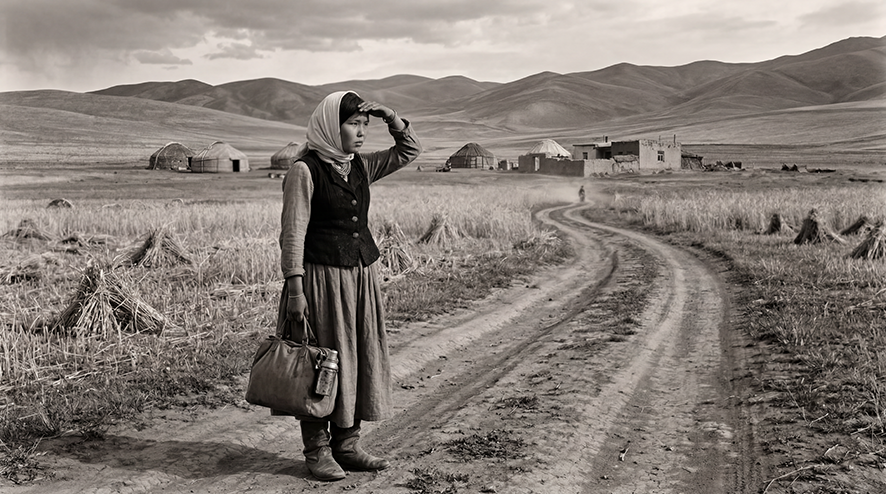
Hers was a story set in the final years of the Second World War, amid the endless steppes of Kyrgyzstan, in the yellowed grasses of the Chu Valley. Chinghiz Aitmatov’s Jamila, written in 1958, was not merely a love story; it was a woman’s journey back to herself. Described by Louis Aragon as “the most beautiful love story of the twentieth century”, the novella broke free from the rigid conventions of Soviet Socialist Realism and rang out like a cry from the depths of the human soul.
The language of the steppe, the poetry of silence
Aitmatov was a child of the Kyrgyz steppe. Born in the Sheker Valley, raised in the foothills of the Tian Shan mountains, he had absorbed the language of the land as if with his mother’s milk. In writing Jamila, he carved out a space of freedom within the ideological mould the Soviet Union had imposed. The geography of the novel was not merely physical; it was a universe in which the soul opened, silence spoke, and the wind wrote poetry. The fields of the Chu Valley, the snow-capped peaks of the Ala-Too range, the flowing rivers and the stretching roads — all were the outward face of Jamila’s inner journey.
Aitmatov’s narrative voice differed from the linear conception of time in Western fiction. He wrote in an epic register nourished by the Kyrgyz oral tradition. His sentences were short, yet his images were boundless. In rendering the silence of the steppe into words, he was in truth telling the untold. Jamila’s face was never described; the gaze of her eyes, the way her hair rippled in the wind, the lightness of her step — these were sufficient. Rather than handing the reader a picture, Aitmatov left behind a feeling.
Cemile: the emergence of an unseen woman into visibility
At the novel’s opening, Jamila was a ghost. She was her brother’s wife, but who, truly, was she? Sadyk was at the front; she worked the fields on horseback. The villagers thought her wild. She did not conform to custom. She sang, she laughed aloud, she performed the same labour as the men. She had a marriage but no existence. She had been defined not as a woman but as a unit of labour.
Seit, fifteen years old, watched Jamila. He was the story’s narrator, but above all he was a witness — the only eye that saw Jamila both before and after she met Daniyar. And what he saw was not a transformation but a revelation. Jamila had always been there; no one had simply looked.
When Daniyar arrived, the steppe did not change. He was a wounded soldier, returned from the front. He had a voice, and that voice touched Jamila’s heart. Aitmatov portrayed love not as passion but as awakening. When Daniyar sang, Jamila listened; yet what she listened to was not the song but the voice inside herself. For the first time, someone looked at her as a human being. For the first time, a man stood beside her without possessing, demanding, or judging.
Love, or existence?
Jamila’s walk toward Daniyar was to be read not as an act of betrayal but as an act of being. For Jamila did not abandon Sadyk; she abandoned her own non-existence. Her marriage to Sadyk had not been a marriage but an arrangement. Families had decided, vows had been exchanged, yet two souls had never met. Aitmatov, countering the Soviet ideology’s rhetoric of “collective happiness”, was defending the freedom of the individual. Jamila’s flight was not an action against the system; it was a flight from a system that was itself against humanity.
Amin Maalouf wrote in Samarkand: “Love is the only road that leads a person back to themselves”. Jamila, too, found her way back to herself alongside Daniyar. But that road did not belong to Daniyar; it was Jamila’s own. Daniyar was not a guide but a mirror. For the first time, Jamila saw her own reflection and recognised it.
In Aitmatov’s telling, love was not physical but spiritual. There were no scenes of passion between Jamila and Daniyar. There were only glances, silent walks, songs carried by the wind. Love was expressed not in words but in the language of the steppe. Two people walked side by side, and the world was remade.
Through Seit’s eyes: the artist as witness
Seit was the novel’s narrator, and that choice was no accident. He was a young painter, and it was as if he were painting Jamila. He did not judge; he observed. As he lived with Jamila and Daniyar’s love, Seit himself learned something: courage, freedom, beauty. Through Seit’s eyes, Aitmatov was saying to the reader: “Look — truly look. For what you see is not a scandal but a miracle”.
Seit’s identity as an artist was the novel’s textual strategy. Through Seit, Aitmatov was reflecting on the function of literature and art. The artist was not one who reiterated society’s rules but one who rediscovered the human being. In narrating Jamila, Seit was rendering her immortal. And so Jamila was transformed from a village woman into a universal symbol.
Geography and the soul: the metaphysical language of the steppe
For Aitmatov, geography was not a setting but a state of mind. The boundless plains of the Chu Valley both isolated and liberated the human being. The steppe, unlike a closed society, was an open universe. Jamila’s flight was a movement from enclosed space (village, home, tradition) toward open space (steppe, road, horizon). Aitmatov employed geography as a psychological element. As Jamila and Daniyar walked across the steppe, they were in truth walking toward themselves.
The oral tradition roots of Kyrgyz literature were unmistakably present in Aitmatov’s prose. The work could be read as an epic poem. Events were arranged not in chronological but in emotional logic. Time was not linear but cyclical. Past, present, and future intertwined. This mode of narration reflected the Eastern holistic perception of things against the Cartesian rationalism of the Western novel.
Soviet reality and the search for freedom
Publishing Jamila in 1958 in the Soviet Union required courage. Socialist Realism demanded that literature serve social utility and that its heroes embody collective values. But Jamila belonged not to the collective but to herself. She heeded not societal norms but her own heart. Aitmatov, remaining within the Soviet system, was nonetheless questioning the spirit of that system.
That the novel was set during the Second World War was also significant. While men were at the front, women had entered the fields of production. Jamila worked the land, yet this physical freedom had not been transformed into spiritual freedom. When the war ended, the men would return and women would once again be shut away in their homes. Jamila’s flight was an act that broke this cycle. She would not surrender to the post-war order.
Jamila’s legacy: the cost of freedom
When Jamila and Daniyar left the village, what they left behind was not merely a community but a worldview. The villagers cursed them; Sadyk’s family was shamed. But Seit remembered them, and he told their story. And in the telling, he said that what they had done was right.
Aitmatov posed the question to his reader: Did Jamila betray, or was she simply honest? When a woman chooses her own happiness, is that a crime? Is love a disruption of social order, or is it the making of a human being?
Jamila was not merely a love story. It was the story of what it means to be human, to possess the freedom to choose, to hear one’s own voice. Jamila did not discover love; through love, she discovered herself. And perhaps the essential question was this: once a person has discovered themselves, could they ever live any other way?
The wind of the steppe still blows. Jamila’s footsteps are still heard. And Aitmatov’s words, even half a century on, still reach the heart: “I told Jamila’s story. But in telling hers, I told, in truth, my own”.