



Sebahattin Çelebi
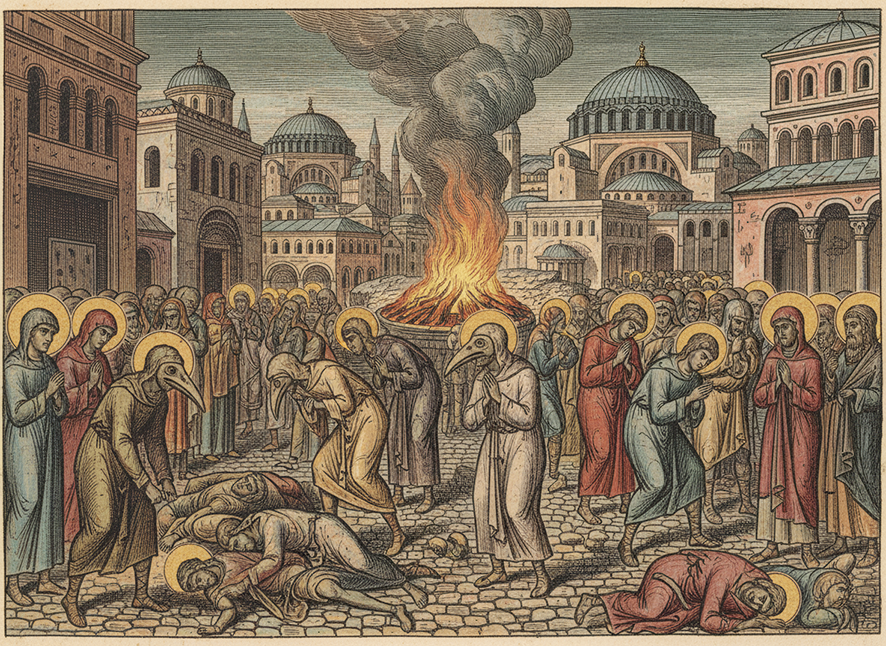
The plague is humanity’s oldest and most silent enemy. It cannot be seen, it knows no borders, it observes no justice. And with each arrival, it brings not only death but also a compulsion to write. As though the pen were obliged to ignite even in the midst of plague fire; as though words could form a shield against microbes, like incense smoke. History has left behind a literary legacy after every great epidemic, because writing is the most primal form of both mourning and survival.
Literature did not merely document the plague; it transformed it, philosophised it, made it metaphor. Viruses became allegory, hospitals became theatre, death statistics became poetry. Every epidemic lifted the veil from society and brought into the light everything hidden beneath: inequality, fear, love, betrayal. Literature’s task was to look upon that nakedness, to sustain the gaze, and to record what it saw in words.
Stories Against the Plague
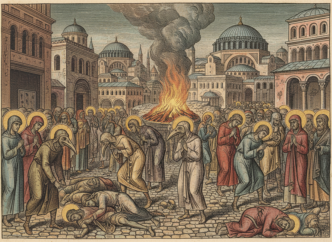
Literature took up arms against the plague with Boccaccio. In the shadow of the Black Death, he gave the world the Decameron — a testament to the enduring power of storytelling. Even as death claimed thousands daily, narrative became a form of resistance, proving that the human spirit could still create beauty and meaning in the face of annihilation.
The work is not merely a collection of tales; it is a throw of the dice against death, a chorus raised against silence. Boccaccio’s discovery would become a legacy for all ages: narrative is a survival strategy. To tell a story is to resist death.
The plague was like a flood sweeping everyone before it, but the pens kept standing in the midst of that flood.
Cholera Laid Bare the Rotting Face of Civilisation
The nineteenth century was the age of cholera. This epidemic, which built bridges from Asia to Europe and America, also brought to light the dirty legacy of the Industrial Revolution: the sewers of cities collapsed, the poor were ruined, the wealthy fled. Thomas Mann, in Death in Venice (1912), deployed the shadow of cholera with great aesthetic mastery. The slow dissolution of Gustav von Aschenbach in the streets of Venice symbolises not only the end of one individual but the inner decay of European civilisation. In Mann’s hand, illness is an instrument: it brings to the surface desires suppressed for years, shatters the disciplined bourgeois life, and even loads death itself with aesthetic meaning, making it almost beautiful.
Gabriel García Márquez, in Love in the Time of Cholera (1985), carried this metaphor into an entirely different dimension. In this epic love story set in Colombia, cholera is both a real disease and the very disease of love itself. Márquez does not romanticise the epidemic; he accepts it as an inseparable part of human experience. He whispers to the reader that love endures even in life’s heaviest moments, that perhaps it is lived most intensely in precisely those moments.
The Spanish Flu Was the Massacre Literature Forgot
The Spanish Flu of 1918–1920 was one of the deadliest epidemics in history, estimated to have claimed between fifty and a hundred million lives. Yet its resonance in literature remained disproportionately silent given the magnitude of that devastation. In the shadow of the great trauma of the First World War, under censorship, the epidemic was never fully processed. One of the rare voices to break this silence was Katherine Anne Porter. In Pale Horse, Pale Rider (1939), Porter told the story of a young journalist in Colorado brought to the brink of death by influenza. Fever, delirium, fear of death, but also war propaganda, social pressure, the instrumentalisation of the female body. In Porter’s hands, the epidemic became a multi-layered metaphor. It laid bare the bitter contradiction between individual pain and collective trauma, and between the promises of modernity and its harsh reality. This literary silence is strange and thought-provoking. It may have to do with the flu’s rapid passage, with the even greater devastation wrought by the war, or with the epidemic being suppressed as a social taboo. Whatever the cause, in the twenty-first century, in the wake of COVID-19, this “forgotten” epidemic returned to the agenda. Historians and writers traced its footprints; suffering long left unclaimed finally found a home.
The AIDS Crisis Carried the Epidemic into a Political Arena
AIDS, which emerged in the 1980s, added a dimension to pandemic literature it had never known before. For the first time, a disease was linked so openly to sexuality, identity politics, social stigma, and state negligence. AIDS literature did not merely narrate the disease and the struggle, discrimination, and grief of the gay community, it simultaneously pushed back, accused, and demanded accountability.
Larry Kramer’s The Normal Heart (1985) brought the desperation and rage of the early years of the AIDS crisis in New York to the stage. The play was a document of indictment: it put the government, society, and the media on trial. While patients were dying, the state remained silent, society stigmatised, the media looked away. The protagonist Ned Weeks fights both the disease and the system. His struggle is not medical but political; it is not a dressing for the wound but a call for justice.
Tony Kushner’s Angels in America (1991–1992) took its place at the summit of AIDS literature. This two-part epic theatrical work wove together the AIDS crisis in Reagan’s 1980s, gay identity, the collapse of the American Dream, spiritual searching, and the weight of history. Realistic scenes were blended with fantastical images; angels descended, ghosts spoke, historical figures appeared on stage. Kushner’s message was clear: AIDS was not merely a health crisis, it was the visible face of American society’s moral, political, and spiritual breakdown.
Susan Sontag, in AIDS and Its Metaphors (1989), examined how the disease was stigmatised and how that stigma caused harm. Sontag was opposed to AIDS being seen as a “gay plague”, to the disease being presented as a moral punishment. ”The healthiest way of being ill is one purified of, is resistant to, metaphoric thinking”, she argued. Yet literature breathes precisely through such metaphors; this tension constitutes both the power and the responsibility of pandemic writing.
Dystopian Epidemics Imagined the Darkest Possibilities
Literature did not content itself with narrating real epidemics; it set about imagining, anticipating, and warning. Albert Camus’s The Plague (1947) was less a real epidemic than an existential and political allegory. The plague besieging the city of Oran was in truth a symbol of fascism, of every form of oppression, of the meaninglessness gnawing at humanity from within. Yet Dr. Rieux goes on fighting even knowing it is meaningless. Because there is no other way to exist.
Richard Matheson, in I Am Legend (1954), reduces humanity to a single man through a viral epidemic. Robert Neville, the last surviving human, spends his nights against creatures who have transformed. But the real transformation is within himself; he comes to realise that he is now the one who is ‘abnormal’. He has become the legend of the new world.
Stephen King, in The Stand (1978), imagined a world in which a flu virus leaked from a military laboratory sweeps away most of the world’s population. The survivors divide between the poles of good and evil; the reconstruction of civilisation is simultaneously humanity’s rediscovery of itself. King’s epidemic is an event that resets the social order, giving humanity both the chance and the obligation to begin again.
In Oryx and Crake (2003) and its sequels, Margaret Atwood tells the story of an epidemic caused by genetic engineering. Her dystopian vision explores the responsibilities of the biotechnology age, the savagery of corporate capitalism, and the fractured relationship between humanity and nature. The epidemic is a catastrophe produced by humanity’s own actions: the inevitable consequence of unbridled scientific research, the hunger for profit and ecological imbalance.
Emily St. John Mandel’s Station Eleven (2014) attempts to filter a light from this darkness. The novel, set twenty years after a flu-like virus has swept civilisation away, focuses on a travelling theatre company formed by survivors. These people, staging Shakespeare under the motto “Survival is insufficient”, prove that art and human connection remain vital even after the apocalypse. For Mandel, memory, aesthetics and a sense of belonging are instruments of resistance amidst ruin.
Coronavirus and Literature
In 2020, the world confronted the greatest epidemic of a century. This time, literature was not a spectator, it stepped onto the stage from the very first day. Writers kept journals, wrote poetry, composed essays. Italian writer Paolo Giordano had completed In the Contagion in the first weeks of quarantine. Arundhati Roy laid bare with merciless clarity how the pandemic deepened India’s inequalities. Voices rose from every corner of world literature; each spoke from its own geography, its own solitude, its own fear.
The pandemic simultaneously triggered a rebirth of the classics. Camus’s The Plague entered bestseller lists across the globe. People found an echo of their own days in a novel written in 1947: quarantine, isolation, uncertainty, fear of death and solidarity. Literature became a guide to living through the pandemic, offering consolation and meaning.
A distinguishing feature of COVID-19 literature was its digital nature. It was written on Twitter, on Instagram, on blogs. Poetry readings were held over Zoom; podcasts relayed quarantine stories. The pandemic also transformed the ways in which literature was produced and consumed. The page shifted to the screen; the writer met the world from the quarantine of their own home.
In Turkish Literature, the Epidemic Was Processed Through Metaphor
The theme of epidemics in Turkish literature has a deep-rooted history stretching from the Ottoman period through to the Republican era. The Ottoman Empire struggled with numerous epidemics over the centuries — plague and cholera chief among them — and this struggle permeated official documents, medical texts and historical records, ultimately finding its way into literature.
In Divan poetry, illness and death were generally treated within a mystical and philosophical framework. The concept of fena, the transience of the world, the inevitability of death, formed the backbone of the verse. Yet direct depictions of epidemics were rare. With the Tanzimat period, under the influence of Western literary forms, social realism deepened and diseases became a more direct subject of narrative.
In Halit Ziya Uşaklıgil’s Blue and Black (1897), for example, tuberculosis, the prevalent disease of the era, shapes the fate of the characters. In Sodom and Gomorrah (1928), Yakup Kadri Karaosmanoğlu fuses images of disease with a critique of social decay. In some of his stories, Sait Faik reflects on illness and death as an everyday reality in Istanbul’s poor neighbourhoods, depicting them with plain sorrow and without dramatisation. The pinnacle of this tradition in contemporary Turkish literature is Orhan Pamuk’s Nights of Plague (2021). The plague epidemic that breaks out in 1901 on the fictional island of Mingheria forms the novel’s backbone. However Pamuk’s real subject is not the plague, it is the East-West conflict, the crisis of modernisation, the final days of the Ottoman Empire and love as a form of resistance to time. Rebellion against quarantine, distrust of authority, the battle between science and tradition, and the eternal tension between freedom and security are all skilfully embedded within the historical context of the epidemic.
The Anatomy of Pandemic Literature Has Not Changed
Pandemic literature, spanning continents and centuries, insistently repeats certain themes. Isolation is always the first: Boccaccio’s villa, Defoe’s closed houses, Camus’s besieged Oran and the global quarantine imposed by the pandemic of 2020. As social creatures, human beings question themselves in solitude and attempt to reconstruct their identity.
The second theme is the invisible enemy. The virus, the bacterium, the germ are invisible to the naked eye. It is everywhere yet nowhere. Air, water, contact, coughing — everything becomes a potential threat. This uncertainty can lead to paranoia and suspicion, and cause social trust to erode.
The third theme is the contradiction between social collapse and solidarity. Epidemics reveal the true face of humanity. Some become selfish, flee and blame others. Others stand in solidarity, make sacrifices and lend a helping hand. In Camus’s The Plague, Dr. Rieux continues to fight despite his awareness of the absurd. In Blindness, Saramago openly and candidly observes humanity’s dark potential. “Boccaccio’s villa, Defoe’s closed houses, In Camus’s The Plague, Dr. Rieux continues to fight despite his awareness of the absurd. In Blindness, Saramago openly and candidly observes humanity’s dark potential. The second theme is the invisible enemy. The virus, the bacterium, the germ are invisible to the naked eye. It is everywhere yet nowhere. Air, water, contact, coughing — everything becomes a potential threat. This uncertainty can lead to paranoia and suspicion, and cause social trust to erode.
The fourth theme is the crisis of trust in science and authority. Epidemics demonstrate the limitations of medicine, the state and science. Science cannot cure every disease. The fifth issue is the search for meaning in the face of death. Epidemics bring death to the forefront of everyday life. This triggers existential questions: Is life worth living? If God exists, why does he permit this suffering? Pandemic literature does not shy away from asking these questions, but nor does it rush to answer them.
Future Epidemics Will Also Generate Their Own Literature
Scientists agree that more epidemics are inevitable due to climate crisis, antimicrobial resistance, globalisation and human-animal contact. Perhaps the mildest one was the warning that was the first wave of the pandemic. Future epidemics may be more lethal, spread faster and be more difficult to control.
And literature will narrate those future epidemics too. Perhaps it already is.
Pandemic literature will occupy an increasingly important place in the future because epidemics will continue to be the defining crises of the twenty-first century.
The Pen Emerged Stronger Than the Epidemic
Pandemic literature is the literature of trauma. But it is also the literature of resistance, of hope, and of meaning. Every line is a challenge written against death. Every character is an attempt to assert their existence against annihilation. Every narrative is a desire to be remembered against being forgotten.
Boccaccio’s tales of escape, Mann’s decadent aesthetic, Camus’ absurdist struggle, Kramer’s political rage, Atwood’s dystopian warnings and Pamuk’s historical panorama all look beyond the epidemic. Disease is merely an instrument; the real subject is the human being. These texts remind us that history is cyclical and that epidemics recur. But each time, humanity narrates and resists again. Literature is the memory of that resistance, a legacy hidden within the pages and left for future generations. ‘We were here, we suffered, we died, but we also lived, loved, struggled and wrote.’
As long as the narrative continues, humanity continues. In future epidemics, of which there is no doubt, literature will bear witness and write in order to resist.