


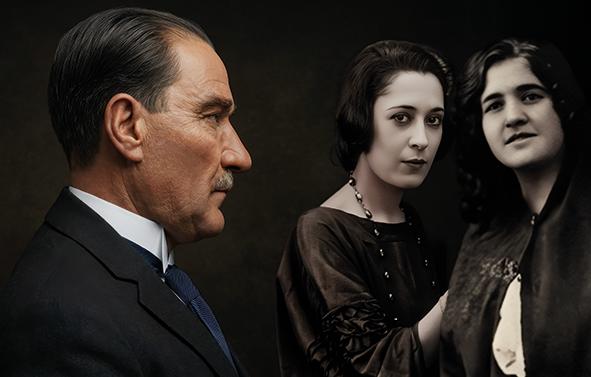

Fikriye is presented merely as a relative, a helper. Yet Fikriye was Mustafa Kemal’s past. The lost gardens of Salonica, the innocent afternoons of childhood. She was not a woman for the Pasha, she was a climate.
Sebahattin Çelebi
History records victories. Marble monuments, signed treaties, those thick borders drawn across maps… But history does not record how the hand that drew those borders trembled by candlelight when night fell. Imagine a man. At the map table, he is overturning the world and rebuilding it. At his command, armies pour toward the Mediterranean; at his glance, parliaments fall into line. Yet that same man, locked in his room within the mud-brick walls of those early days at Çankaya, buries his face in his hands and says: One of the mistakes I made in my life was getting married.
To whom does he say this? Perhaps to Kılıç Ali, perhaps to Salih Bozok. But in truth, in that moment, he is speaking to himself, talking to his own echo. You see, he says, his voice slightly broken, slightly abashed, I commanded armies, I commanded parliaments, I fought wars, I won them, but I cannot command a woman.
Mustafa Kemal. A legend, a genius, a supreme commander. But when he removes his uniform, when he hangs those braided epaulettes, those heavy medals on the coat rack, only Mustafa remains. And that Mustafa, caught between two great loves, two great women, two separate worlds; who conquered the globe but could never quite conquer his own heart, was, in truth, a defeated man.
Fikriye: The Mist of Former Times
The story is always told a little incompletely in the history books. Fikriye is presented merely as a relative, a helper. Yet Fikriye was Mustafa Kemal’s past. The lost gardens of Salonica, the innocent afternoons of childhood. She was not a woman for the Pasha, she was a climate.
In those darkest, most gunpowder-scented days of the National Struggle, in Ankara’s time of deprivation, Fikriye was there. At the Directorate Building, in that ramshackle station house, it was she who listened to Mustafa Kemal’s cough, who sewed on his loose buttons, who offered him the warmth of a home with tables she conjured from nothing. Even Zübeyde Hanım, that stern-natured, hard-to-please Rumelian woman, had taken Fikriye to her heart. Because Fikriye loved Mustafa. Not the Pasha, not the Gazi, but Zübeyde’s son, fair-haired Mustafa.
Fikriye’s love was like a candle flame: silent, calm, but burning without pause. She was a harbour that stilled the storms in the Pasha’s life. When she took up her oud, when those slender fingers touched the strings, the room was at once cleansed of the noise of war and transformed by that haunting mountain song into a place of shelter.
But Fikriye was ill. The wasting disease. In her lungs was no ordinary moth, it was the weight of that great, that impossible love. And the Pasha, with that merciful, that Eastern side of himself, wished to protect Fikriye. As he sent her to Munich for treatment, did he know he was sending her into exile? When Fikriye left, she had not only left Ankara behind, she had left her soul there too.
The Flames of Izmir, the Uşakîzâde Mansion, and Paris
And Izmir. The great fire. While the city burned, the real fire had begun in that white marble mansion in Göztepe. As Mustafa Kemal searched for a headquarters amid the dust and smoke of victory, fate led him to the mansion of Uşakîzâde Muammer Bey.
The woman who received him at the door bore no resemblance to Fikriye. She was slight perhaps, but in her eyes there was a century’s worth of self-possession; in her bearing, the proud air of Europe. Latife. The daughter of the Uşakîzâdes, one of Izmir’s most established merchant families. An intellectual who had read law at the Sorbonne, attended political lectures in London, and spoke French, English, and German.
Mustafa Kemal was taken aback. This was not one of those modest Anatolian girls who trembled at the sight of a commander and reached for the hem of his coat. When she said this mansion is yours, Pasha, her voice did not waver. When she said Izmir has been waiting for you, her eyes were saying I have been waiting for you.
Those days, the days when the dream of a new state was being born from the ashes of Izmir. Latife did not merely play host to the Pasha; she enchanted him. Not only with her beauty but with her intellect. She translated his English correspondence, leaned over the maps, and on those evenings in the white mansion, sat at the piano and played Tchaikovsky. The gunpowder scent of war had given way to the crystal sound of the piano and the Paris-scented perfume of Latife. This, said Mustafa Kemal, is the spirit I have been seeking. The woman who will present me to the world.
Latife was also courageous. When assassination reports came in, she was brazen enough to stand guard at the Pasha’s door with a weapon in hand, and devoted enough to say the bullet meant for you shall come to me. This loyalty and this modernity erased, for a time, the sorrow of Fikriye from Mustafa Kemal’s heart.
A Revolutionary Wedding and the Shadow of Zübeyde Hanım
Yet it was Zübeyde Hanım who saw this love in its clearest, most unguarded form. Before her son entered Izmir, ill as she was, paralysed, she rose and wanted to go to Izmir. What had she said to aide Salih Bozok on the road? There is some Lütfiye in Izmir. My son has taken a liking to that girl… Let me go and see what sort of girl she is.
She could not even say her name quite right, she called Latife “Lütfiye”. But her heart’s eye was open. When she met Latife, when she surveyed this modern girl, that old woman made an observation that would go down in history: This girl does not know that she does not love my son. She loves Mustafa Kemal Pasha, she loves Gazi Kemal Pasha. She does not love Mustafa Kemal Efendi. Zübeyde Hanım was folded into the soil of Izmir before she could say this to her son, before she could say I have a bad feeling about this.
On 29 January 1923, immediately after his mother’s death, they married. But this was no ordinary wedding. It was a manifesto. When they sat at the marriage table, something unprecedented occurred. Latife Hanım had cast aside the thick veil covering her face and sat beside Mustafa Kemal as his equal. The witnesses were Fevzi Çakmak and Kâzım Karabekir. This was not a wedding, it was a declaration of revolution. By marrying Latife, Mustafa Kemal was signalling the new place of Turkish women.
The Heel Symphony and Clashing Powers
They married. But Çankaya Mansion swiftly became not a nest of love but a frontline in a war of authority. Latife, with the refinement of the Uşakîzâdes and the education of the Sorbonne, arrived at those mud-brick rooms and declared: I am here too. She was strong. She was forceful.
She changed the order of the mansion, changed the tables. Those famous dinner conversations, those evening-to-dawn blends of ideas where affairs of state were discussed. Latife was uncomfortable with them. She did not wish to be merely a listener at that table. When the Pasha lingered downstairs, extending his conversation with his companions, Latife Hanım upstairs, in the bedroom, would begin striking the floor with her hard-heeled shoes. Tak, tak, tak. This sound was the famous Heel Symphony, passed from tongue to tongue.
That sound was a warning. It was an order: finish now, come upstairs. The great Supreme Commander, the man who had defied the whole world, would grow abashed before those heel strikes and say to his companions: Shall we be off then, boys? Two captains were sinking the ship. While Mustafa Kemal sought peace and tranquility at home, he had found across from him a teacher who was constantly demanding, constantly correcting, and occasionally stepping so far forward as to wave at deputies from the parliamentary balcony. Love was slowly turning into an arm-wrestling match.
A Morning in the Garden: The Moment the Names Were Confused
The moment the threads snapped, how human, how tragic. One morning, in the garden of Çankaya, they were watching a dog that had just given birth to puppies. The Pasha was cheerful, smiling. He turned to Latife beside him, about to say something. But it was not Latife that fell from his lips, it was Fikriye.
A momentary lapse. The treacherous game of the subconscious. But this mistake became the final drop that caused the cup to overflow. For Latife, it was an unforgivable insult. After all that quarrelling, all that noise, for the name of that other woman, the old one, the other, to fall from her husband’s mouth. It was more than enough to begin the separation of beds, the beginning of that great crisis. Mustafa Kemal, perhaps in that moment, understood: his soul was not seeking the bright light of modernity, it was still seeking the dimness of that old tenderness.
A Blood-Red Rose and the Sound of Carriage Wheels
At that very moment, the forgotten shadow, banished to those distant, grey rooms of Munich, returned. Fikriye. The longing was worse than the wasting disease. When she appeared at the gates of Çankaya, the doors of the house that had once been her home were shut in her face. Latife Hanım’s order was clear: she was not to be received.
The guards at the gate bowed their heads. Fikriye understood. Her home, her country, her love, everything, all had been taken from her. She stepped into a carriage. As it descended the slope from the mansion, she reached into her bag for the mother-of-pearl-handled Browning. The weapon Mustafa Kemal had once given her as a gift. And that sound, a single gunshot tearing through the silence of Ankara.
Fikriye did not die immediately. She lay in a hospital room for days, between life and death. The doctors said suicide; the files were closed. But all of Ankara knew: even if the finger that pulled the trigger was Fikriye’s, what had pulled that trigger was loneliness, rejection. When Mustafa Kemal received the news, he shut himself in his room. That gunshot never left his ears for the rest of his life.
Divorce and the Fading of the Yellow Roses
Fikriye’s shadow was the final nail hammered into the coffin of the marriage with Latife as well. The dead are sometimes stronger than the living. And at last, that mistake of two years, six months, and four days came to an end.
Latife Hanım left. Proud, head held high, but inwardly in ruins. She was silent until she died. She never spoke a single ill word about Mustafa Kemal; she kept his letters, his secrets, locked in trunks. Mustafa Kemal, for his part, was left utterly alone at Çankaya. Neither Fikriye’s maternal tenderness remained, nor Latife’s intellect.
In those days, he took to gazing longer at the yellow roses in the garden. In our lands, they say the yellow rose is parting. It is sorrow. From Latife Hanım’s home, too, yellow roses never went missing until the day she died. Without speaking, without seeing one another, they communed for years in the mournful tongue of yellow roses.
When on a certain day he turned to Kılıç Ali and made that confession, he was in truth summing up his entire life: I commanded armies, but I could not command a woman. For love obeyed no chain of command. Love was not managed by regulations and decrees. And Mustafa Kemal, that great revolutionary, had been unable to suppress the rebellion in his own heart; in that inner war, he had been defeated.
He lies now in Anıtkabir. Alone. And when we read his story, it is not his victories that we love, it is precisely these defeats, these human frailties. Because then we understand that inside the man who stands so upright, there lives a human being who loves as we do, makes mistakes as we do, says if only as we do.
Clash of Characters
Latife Hanım possessed a strong, wilful, and jealous nature. Atatürk, by contrast, was someone who wanted a constant crowd around him, long dinner conversations, mixed assemblies of men and women. Latife Hanım at times attempted to curtail this environment with considerable firmness.
Allegations of Political Interference
Statesmen and those close to Mustafa Kemal felt that Latife Hanım interfered too much in affairs of state, in the arrangement of appointments, and in Mustafa Kemal’s decisions. In certain circles, the murmur circulated: it is she who governs Çankaya.
The Ali Fuat Cebesoy Matter
According to some accounts, Latife Hanım adopted an attitude toward old comrade-in-arms Ali Fuat Pasha that amounted to driving him from Çankaya. This caused deep grievances among Mustafa Kemal’s inner circle.
Personal Exhaustion
Atatürk’s nocturnal lifestyle, his drinking table, his impulsive decisions, and his unpredictable schedule became increasingly unbearable for Latife Hanım, who desired an orderly and disciplined domestic life.
Separation: A Will Expressed in a Single Sentence
On 5 August 1925, as Mustafa Kemal was departing Çankaya Mansion, he informed Latife Hanım that they were divorced. The divorce was carried out by the talaq procedure of Islamic law, which was still in effect at the time, that is, unilaterally, by Mustafa Kemal’s spoken will. The official Civil Code would not come into force until 1926. The end of this marriage was therefore, in the fullest sense, one of the last great applications of the old law, a historical irony.