




Leo Tolstoy: “Please regard me as a good Muslim, and all will be well”.n fostering a sustainable future.
Hürrem Erman
These lines come from a letter written in April 1884 at Yasnaya Polyana. Leo Tolstoy addressed them to Countess Alexandra Andreyevna Tolstaya, both a close relatinion and a trusted friend. Twenty-six years after that letter, on a cold November day in 1910, it is said that in the room where he drew his last breath at the stationmaster’s house in Astapovo, a prayer rug lay aligned toward the Qibla.
And so the question presents itself: was Leo Tolstoy, regarded not merely as one of the greatest writers of Russian literature but of all world history, perhaps a Muslim?
Before we attempt to answer that question, let us come to know this great writer a little more closely.
The Childhood of a Seeker
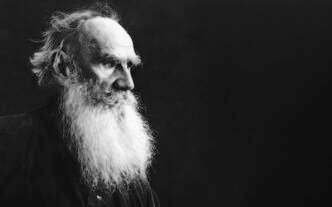
Leo Nikolayevich Tolstoy was born in 1828 on the Yasnaya Polyana estate in the province of Tula, the child of one of Russia’s most distinguished families. The loss of his mother when he was barely two years old, and of his father when he was nine, left deep wounds in his soul. These early losses were perhaps the first seeds of his lifelong search for truth.
Among the most significant moments of his childhood were the tales of Leo Stepanych, a blind storyteller who lived in his grandmother’s house. In a monotonous, singsong voice, he would recount stories of King Shahryar and his brother King Shahzaman, and of “the just God”. These stories drawn from One Thousand and One Nights left a profound impression on the young Tolstoy. Years later, in 1891, when the Moscow publisher Michael M. Lederle asked him which books had most influenced his life, he placed One Thousand and One Nights among the books of his fourteenth year.
This early encounter laid the groundwork for his lifelong interest in Eastern culture. In the school for peasant children he founded in Yasnaya Polyana in 1862, he adapted some of these tales and used them in his pedagogical writings. The two stories Dushenka and The Forty Thieves and the Unjust Verdict were products of his early contact with Islamic culture.
Kazan and the Orient
He subsequently studied law at the University of Kazan, but also attended courses in Oriental Studies at the Faculty of Arabic and Turkish Studies, in the hope of a diplomatic career. Kazan at that time served as a bridge between Eastern and Western culture. The standard of instruction in Oriental languages at the university was extraordinarily high. As Edward Tracy Turnerelli expressed it: “In this branch of education there is no other institution in the world that offers students so many advantages as the university of this city”.
It was here that Tolstoy began to learn Arabic. Decades later, in 1909, he would regretfully observe that he had studied Arabic in Kazan but had forgotten almost everything “except reading and a few words”. Yet he continued to believe that an Oriental education was more appropriate for Russia than a classical one.
In the Caucasus: An Encounter with Islam
In 1851 he went to the Caucasus with his brother Nikolai. There he had the opportunity to meet millions of Muslims living within the Russian Empire. He bore witness to the struggle of Sheikh Shamil, the spiritual and military leader of the Muslim tribes of the Caucasus. These experiences would form the foundation for his masterwork Hadji Murat.
During the more than two years he spent in the Caucasus, the During the more than two years he spent in the Caucasus, the locals bestowed upon him the title of “Dzhigit”, a person of courage and honour. This was an extraordinary distinction for a Russian nobleman. The Islamic mystical tradition of Muridism, with which he came into contact there, left traces in his religious thinking.
The Great Works
War and Peace is not merely a novel; it is an epic of humanity. This work, which traces Russia’s historical passage through the Napoleonic invasion between 1805 and 1812, holds a singular place in literature. Pierre Bezukhov’s spiritual quest, Prince Andrei’s struggle between life and death, Natasha Rostova’s innocent beauty, each figure represents a different facet of the human condition.
As the French writer Romain Rolland said: “Tolstoy’s works are like the sea. At each dive one finds new pearls”.
Anna Karenina stands at the summit of the modern novel. This work, which Dostoyevsky described as a “perfect thing”, is not merely the tragic story of a woman but a panorama of social transformation, moral decay, and spiritual searching.
The Spiritual Crisis and the Turn Toward Islam
The deep spiritual crisis he passed through in the late 1870s led him not only toward Christianity but toward all the world’s religions. As he wrote in his Confessions, the questions “Does life have meaning? Will death not destroy everything?” gave him no rest.
In the course of this search, he read the Quran and studied the Hadiths of the Prophet Mohammed. In that celebrated letter to Alexandra Tolstaya of 1884, he responded to the reactions of those around him with these words:
“Some, liberals and aesthetes, take me for a madman or a simpleton like Gogol; others, revolutionaries, radicals, see in me a mystic, a babbler; government officials regard me as a dangerous revolutionary; the Orthodox see in me the devil… And therefore, please regard me as a good Muslim, and all will be well”.
The Deepening of Islamic Conviction
Tolstoy’s view of Islam deepened over the years. In March 1909, during a conversation recorded by his physician Dushen Makhovitsky, he said:
“Mohammed always stood higher than Christianity. He does not consider man to be God, and never equates himself with God. Muslims worship nothing but God, and Mohammed is His messenger. In this there is no mystery and no doubt”.
In the same conversation, his response to his wife Sofya Andreyevna’s question, “Which religion is better: Christianity or Islam?”, was remarkable:
“It is clear to me that Islam is better and higher… Islam has enlightened me greatly”.
These words surprised his wife and provoked an objection, half in jest, half in earnest, on the subject of polygamy.
The Letter to Elena Vekilova
In a letter to a woman named Elena Vekilova in March 1909, the mature form of Tolstoy’s thoughts on Islam reveals itself plainly:
“In my opinion, Mohammedanism in its outward forms stands incomparably higher than church Orthodoxy. If a person is offered only two options, to remain within church Orthodoxy or to convert to Mohammedanism, then for any reasonable person there can be no doubt about this choice. And everyone will prefer Mohammedanism to the complex and incomprehensible dogma of the Trinity, of redemption, of the sacraments, the Mother of God, the saints and their icons, and the elaborate forms of worship, and will instead accept the dogma of the one God and His Prophet”.
The Hadith Project
In 1905, Tolstoy came across Abdullah al-Suhrawardy’s book The Sayings of Muhammad. This book became a turning point for him. According to the testimony of his daughter Alexandra, the work was among the books that lay on Tolstoy’s reading table in the final years of his life.
He was so struck by the work that he began corresponding with al-Suhrawardy and expressed his wish to translate it into Russian. In 1909 he published his own collection under the title Selected Sayings of the Prophet Mohammed. In his preface he wrote:
“Anyone who wishes to confirm the tolerance within Islam should read the Quran carefully. Its verses reveal the exalted spirit of Islam: “And hold firmly to the rope of Allah all together and do not become divided…” (Āl ‘Imrān 103)
Among the hadiths included in this collection were:
“Allah has mercy on those who show mercy. Show mercy to those on earth, and He who is in heaven will have mercy on you”.
“A believer is not one who fills his stomach while his neighbour goes hungry”.
“What are the most perfect deeds? To gladden a person’s heart, to feed the hungry, to help the oppressed, to ease the grief of the sorrowful, and to restore to victims their rights”.
The Universal Religion
In a letter to the Egyptian Mufti Mohammed Abduh in 1904, he declared that despite coming from different religions, they shared the same faith:
“Religions are diverse and many, but there is only one faith, the true one… To acknowledge God and His law, to love one’s neighbour, and to do unto others what one wishes for oneself. In my view all true religious principles derive from this and are alike for Jews, Brahmans, Buddhists, Christians, and Muslims… The more the religions purify themselves of superstition, the closer they come to the ideal of a common unity”.
In his “Reading Circle” project, developed in 1884, he aimed to gather the most valuable thoughts of the foremost representatives of humanity. Of it he wrote:
“We have passed the thoughts of wise men, formed over millennia among all the nations, through the sieve of time… What remained were only those independent, self-aware, and necessary thoughts preached by all the sages of the world: Zoroaster, Buddha, Laozi, Confucius, Socrates, Plato, Epictetus, Marcus Aurelius, Jesus, Mohammed, and among the moderns, Rousseau, Pascal, Kant, Emerson, Channing, and others”.
It is worth noting that he counted the Prophet Mohammed in this list among the great sages.
On the Prophet Mohammed
Tolstoy’s admiration for Islam was not merely theoretical. He regarded the Quran as a consistent book that proclaims love and forbids war for the propagation of Islam. In his diary entries of 1909 he wrote:
“What the religions hold in common is found also in the Quran: the proclamation of love. The Quran is consistent, and Mohammed forbade war and killing for the spread of Islam… In truth, we do not know Islam as well as Muslims know Christianity, and a nation without religion is condemned to a wretched condition..”.
On the Prophet Mohammed himself he wrote:
“I am among those who are deeply impressed by the Prophet Mohammed, chosen by the One God to send down His final message through his soul, his heart, and his mind. He was chosen to be the last Prophet; therefore after him no further prophet will come… Without doubt, the Prophet Mohammed is one of the greatest reformers who rendered immense service to the human community… He led an entire nation toward the light of truth and guided them to peace and tranquillity”.
The Final Days
In October 1910, tensions within Tolstoy’s household reached their highest point. The rift with his wife Sofya was not merely personal but philosophical. On the night of the 28th of October, the eighty-two-year-old Tolstoy left the house at midnight. He boarded a train with his daughter Alexandra and his physician Makhovitsky. At Astapovo station he fell ill and was lodged in the house of the stationmaster.
He lay gravely ill for ten days. During that time, telegrams arrived from around the world. Journalists, government representatives, and friends gathered at the door of the railway station, everyone wished to know the final moments of the great master.
On November 20, 1910, in the first light of morning, Tolstoy breathed his last. His final words, spoken in the presence of his daughter, were: “I am seeking the truth!”
That morning it passed unnoticed, but it is said that in the room in which he died, a prayer rug lay aligned toward the Qibla. Was this deliberate, or was it a rug that had happened to be placed in that direction? History has left this question suspended in uncertainty.
The Legacy
Contemporary Russian researchers note that Tolstoy’s admiration for Islam “was concealed from readers for many years”. The Russian government did not want a famous count to be seen spreading Islamic wisdom, fearing that such a situation might encourage Russians to question their own faith.
Perhaps Tolstoy’s true religious identity is as mysterious as the universal truth he spent his entire life seeking. Perhaps he was too vast a soul ever to have remained within the boundaries of any single religion. Or perhaps those words in that 1884 letter were genuinely the voice of his heart.
Tolstoy’s relationship with Islam is one of the most beautiful expressions of his understanding of universal religion. He said in 1909:
“Throughout my life I have always encountered Islam with great respect, and I believe that Islam compares favourably with Orthodox teachings”.
His grave at Yasnaya Polyana stands as one of the most powerful testimonies to his convictions. On the grave there is not a trace, not a sign belonging to Christianity or to any other faith. It is utterly plain. Exactly like the grave of the Prophet Mohammed.
Perhaps the most fitting words ever written about him are these: “Tolstoy was not merely a Russian writer; he was the conscience of humanity”.
And the conscience always seeks the same truth, whatever religion it belongs to, whatever book it consults: love, justice, peace.