


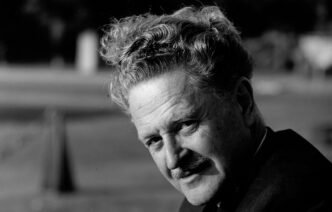
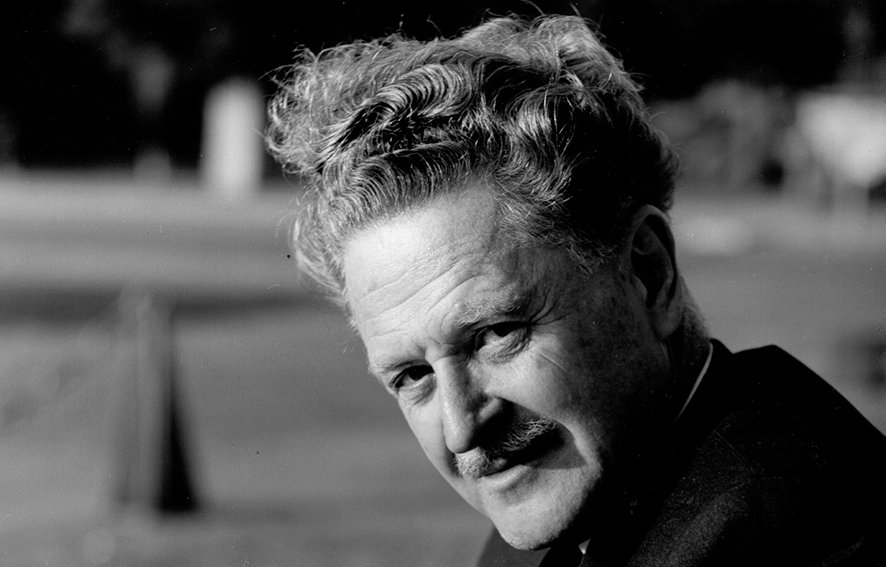

Nazım Hikmet, the greatest poet of modern Turkish lyric poetry, is, with the new language and new understanding he brought to the art of poetry, the greatest revolutionary of verse.
MEHMET YILDIZ
“I would like to wake for half an hour after my death—to see my heart, which has caused me so much pain, and to witness your weeping”.
His view of the way literature reflects and interprets reality can be seen in this statement: “Modern realism in literature is the conscious application of dialectical materialism to the field of literature”. He was the first writer to translate the philosophy and transformative force of societies into literary practice.
Had one wished for a portrait of a beautiful child, his mother Celile Hanım could have painted Nazım. From the marriage of Hikmet Bey, son of Nazım Pasha and Celile Hanım, daughter of the linguist Enver Pasha and Leyla Hanım, Nazım was born on 15 January 1902, on a cold winter’s day, with blond hair and sky-blue eyes. The names of both his grandfather and his father: Nazım Hikmet. His father Hikmet Bey served in the Ottoman foreign service. His mother Celile Hanım, was among the first female painters of the country, an enlightened, cultured woman.
Nazım was Türkiye’s most vocal champion of socialismthat spread across the world with the October Revolution. For this, he was forced to leave his country and was subjected to poverty, imprisonment, oppression, and slander. He did not give up, did not despair; even in prison he bore no grudge against his country and his people, did not turn away from them, and this “blue-eyed giant” wrote some of the greatest epics about the people of Anatolia. With his first book, 835 Lines, published in 1929, he proved that he drew from the sources of Divan and folk poetry in Turkish, developed that tradition further, and created a modern lyric voice. As the first practitioner of free verse, he became the pioneer of contemporary Turkish poetry. Through his plain, distinctive language, the diversity of his themes, and his cosmopolitan perspective, Nazım Hikmet ensured that Turkish lyric poetry gained international recognition. Yet the price he paid was very high. In 1951, his citizenship was revoked.
From a young age, he received his early education from his mother and at the poetic gatherings attended by other family members and began pouring words into verse. Nazım, who completed his secondary schooling at Galatasaray and Nişantaşı schools, entered the Naval Academy in 1915. That same year, his first poem was published in a journal. With the occupation of Istanbul, love poems gave way to patriotic verse. He later left the Naval Academy due to illness. Distressed by the treatment of his people in the territories plundered by the Greek occupiers, he and his close friend Vala Nurettin set out for Ankara in the days when Mustafa Kemal was departing for Samsun, to join the Anatolian movement. Nazım, who until 1921 had been a committed nationalist, met in İnebolu a man named Sadık Ahi, along with Nafi Atıf Kansu and Vehbi Sarıdal, who introduced him and Vala about Marx, Engels, and Kautsky, names they had not previously known.
When Nazım and Vala arrived in Ankara, Press Director Muhittin Bey asked them to write poems to win Istanbul’s youth over to the cause. When the sultan’s followers responded to their poems, Muhittin Bey transferred them to Bolu, Nazım as a Turkish teacher, Vala as a French teacher. During their time in Ankara, the young men met Mustafa Kemal, who recommended they write “poems with purpose”. Drawn by the struggle in Anatolia and by communism, and wishing to understand the Soviet Revolution more closely, they travelled via Batumi to Moscow. Nazım became a member of the Communist Party.
Life resembles a game of chance. Had everyone deserved both a presiding judge at the criminal court and a roommate who explained the ideas of Marx and Lenin? Ziya Hilmi was Nazım Hikmet’s roommate when the latter was posted as a teacher to Bolu. He was very orderly. Nazım was not. While attending to the housework on one hand, he played the role of elder brother to Nazım on the other. It is astonishing how his long imprisonment under severely restricted and difficult conditions, far exceeding the days he freely enjoyed the sunlight, contributed to his creativity, his relationships, his teaching, his ability to organise himself and others simultaneously, and to his worldwide recognition.
Nazım Hikmet returned to the country in 1924 and became a member of the Communist Party of Türkiye, but when the arrests began, he went to Moscow again in 1925. Although he returned to the country once more in 1928, he could not escape brief arrests. In 1929 his book 835 Lines was published. In 1933 and 1937 he was arrested for various reasons, and finally in 1938, charged with inciting the army to rebellion and combined with earlier sentences, he was condemned to a total of 28 years and 4 months in prison. After some time in the prisons of Ankara and Çankırı, he was transferred to Bursa Prison, where he remained for ten years until he was released in 1950 under a general amnesty law. His release did not set him free. To escape the danger closing in around him, in 1951, following a plan he had worked out with Refik Erduran, he left his homeland forever and made his way via Bucharest to Moscow. He spent the remainder of his life in Moscow, undertaking various journeys across the world. Into his relatively short life were packed many loves, marriages, and children, and his love affairs he recounted to his readers in his poems with open language and full emotional intensity.
Nazım Hikmet, the greatest poet of modern Turkish lyric poetry, is, with the new language and new understanding he brought to the art of poetry, the greatest revolutionary of verse. His boldly composed poems in new form were at first criticised by intellectuals who clung to the old conception, but later found admiring recognition as well.
”Nazım had found his own path at the point where his innovative line of departure crossed with a return to tradition, and was able to develop his personality from that intersection”.
Nazım, one of the greatest masters of the Turkish language, was not only a poet. He was simultaneously a journalist, a prose writer, and a playwright. With his poems and writings spanning thousands of pages, Nazım Hikmet is a significant thinker who always chose the path of connecting national culture with the shared values of peoples and of humanity, and who reflected on art, philosophy, politics, and the fundamental problems of humankind. He fought his entire life, ceaselessly, for a classless society in which every human being could express themselves freely and every class and stratum would stand equal.
Nazım as Painter
Looking at Nazım’s lineage, one finds that the family contained artists, poets, writers, and painters. His grandfather Mustafa Celalettin Pasha had graduated from the engineering school and risen to the rank of Pasha. He could draw maps and painted wonderful pictures. His mother Celile Hanım was at the forefront of those who opened this path for him. The portraits and drawings on the pages of his poems from the prison years are expressions of Nazım’s powers of observation. In prison, Orhan Kemal observed Nazım and even noted the whistling he made while painting. With the portraits he drew in Çankırı Prison for Piraye, whom he called “my wife, my soulmate”, Nazım gave expression to his love and longing for his wife.
Film and Theatre Work
In the 1930s, Muhsin Ertuğrul visited Nazım and asked him to write some plays. Not wishing to disappoint this leading figure of Turkish theatre, Nazım wrote for him the pieces Kafatası (The Skull) and Bir Ölü Evi (A Dead Man’s House). Later, in 1933, he wrote the screenplays for the films Söz Bir Allah Bir and Cici Berber.
”That directness, simplicity, plainness, absence of glitter and velvet are necessary in art and in life, this I learned from the operas I saw at the Bolshoi. How the constantly moving, constantly changing composition should be, not only in ballet but also in drama, in the novel, in poetry, I learned from the ballet The Beautiful Joseph”.
Nazım was engaged, both in prose and in lyric poetry, in establishing formal possibilities and searching for their potential usefulness. He even said that he saw the fundamental difference between genres “not in quantity but in quality”. That is, in his conception, what makes a novel is not its length but its nature. The choice of subject in novels, indeed the very social content of the novel, is, from the perspective of the worldview Nazım held, a necessity. It is possible to recognise this stance in all his works and in his views on literature.
His Poems
Although he grew up in an enlightened family environment, during his time at the Naval Academy on Heybeliada he came to know the renowned poet of his era, Yahya Kemal Beyatlı; and in Russia, where he went in his twenties, he befriended Mayakovsky, one of the greatest poets of all time. The turbulent epoch of his country brought him into contact with the human reality, the art, and the social problems of his time. Nazım, who already in his earliest syllabic-metre poems went beyond the conventional and opened the doors to a new and striking poetic world, gave Turkish lyric poetry its first poem in free verse with Açların Gözbebekleri (The Pupils of the Hungry), a work he encountered in Russia and rewrote in new form. When his first poetry collection 835 Lines appeared in 1929 upon his return from Moscow, it triggered a revolution in Turkish lyric poetry. In rapid succession followed Jokond ile Si-Ya-U, Varan 3, Sesini Kaybeden Şehir (The City That Lost Its Voice), Benerci Kendini Neden Öldürdü (Why Did Benerci Kill Himself), Portreler (Portraits), and Taranta Babu’ya Mektuplar (Letters to Taranta Babu).
One could write pages about his personality as artist, writer, and communist. It would have been impossible to speak of this versatile blue-eyed giant without mentioning the affairs of his heart, the women who entered his life or whom he loved. He was a man of the heart. The hearts of heartfelt people never remained empty, whatever the circumstances. And so his did not remain empty either.
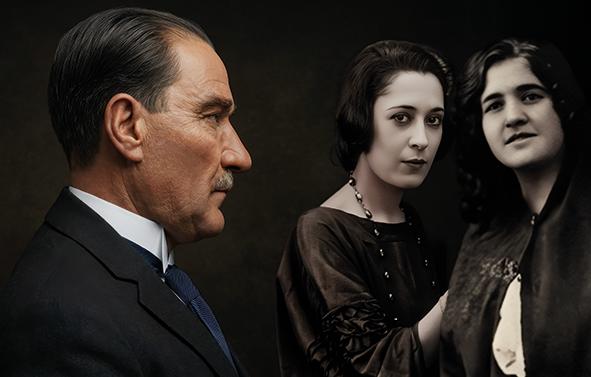
Celile Hikmet Hanım was on the lips of all Istanbul, both for her paintings and for her beauty. She was the most talked-about woman in Istanbul society. Yahya Kemal, who came to their home to teach Nazım, fell in love with this singular beauty. But due to Nazım’s resistance and Yahya Kemal’s refusal to marry, Celile Hanım went abroad. The divorce of his mother and father struck Nazım deeply. He held his poetry teacher Yahya Kemal responsible. On a day when the latter came for lessons, Nazım left a note in his teacher’s jacket pocket. With that note, the young poet issued something of a challenge to Yahya Kemal, his literature teacher: “The house you entered as my teacher, you will not enter as my father”.
Nüzhet had grown up in the same neighbourhood; they were childhood friends, and Nüzhet was Nazım’s first love. In 1921, while he was a student at the university in Moscow, they married on impulse. Nüzhet’s family did not consent to the marriage. They wrote letters to Moscow: “Rebellious with every word, every gesture, against everything, even his hair has rebelled against the barber’s comb, a docile and gentle girl like you will not be able to get along with this man!”
But this marriage begun in love did not last long. After two years together, Nüzhet fell ill, returned to Istanbul, and left Nazım also under the influence of her family. This abandonment struck him deeply. He could not forget Nüzhet for a long time. Out of jealousy and the feelings stirred by being left, he wrote the poem Gövdemdeki Kurt (The Worm in My Body).
Piraye was a close friend of Nazım’s sister Samiye. Red-haired, striking, enlightened, raised in a cultivated environment and from a prosperous family. And Piraye was at the same time divorced from her husband, a widowed woman with a son and a daughter. At the frequent visits to Nazım’s home in Kadıköy they came to know each other and fell in love, but the long prison years that began at that time drove them apart. Yet these long separations, begun with Nazım’s prison years, only strengthened their bond and their love further, and Nazım wrote his love poems, among the finest examples of Turkish lyric poetry, always for this “red-haired woman”. In 1935, when Nazım was released following the amnesty, he and Piraye finally married. But this marriage too was interrupted by political pressure, economic hardship, and years of forced separation. The hopelessness of the years Nazım was to spend in prison between 1938 and 1948 would be eased by the support of his mother and his friends, and by Piraye’s brief visits and her love. In the long prison years, when Nazım fell into hopelessness, he proposed to Piraye that she divorce him. Piraye’s reply was: “Even if you were sentenced to 101 years, know that I stand behind you”.
This passionate love lost its fervour one day, and Nazım sought the excitement he craved in other relationships. Naturally this situation wounded Piraye’s pride and broke her heart. The novelist Cahit Uçuk and the opera singer Semiha Berksoy were among the women who entered his life in his days of hopelessness. In the end, Piraye had to meet all of this with understanding and forgive him. Nazım’s relationship with Münevver became the final drop that caused the cup to overflow.
In 1952 he met the young Russian doctor Galina, the beginning of a new love for Nazım. Galina was his doctor, his life companion, his domestic partner, his health adviser, the supervisor of his eating and drinking and his entire life, his wife on shared journeys abroad, and at the same time a state employee who monitored him on behalf of Russia. Although Nazım wrote no love poems for Galina, he had with her his longest relationship.
But on Nazım, who lived with Galina while longing for Münevver, a new love waited. Towards the end of 1955 he met Vera by chance. What the poet did not know at that moment, however, was that Vera was married and the mother of a daughter. This love, striking like lightning, revived Nazım anew, brought back his joy in life and his enthusiasm. He began pressing Vera to divorce her husband so that they could live together, and became consumed with longing for her.
Vera is the woman Nazım immortalised with the 1961 poem Saman Sarısı (Straw Blonde), in which he spoke of “straw-blonde hair, blue lashes, and full red lips”. The love of Vera, thirty years his junior, made Nazım lose his head. This young beloved now became the source of inspiration for new love poems. At the beginning of 1960, what had long been anticipated finally came to pass. Nazım’s eight-year relationship with Galina ended in divorce. Vera too, after long and agonising years, managed to separate from her husband. At last Nazım reached Vera, the woman he had loved from the first moment of their meeting, that is, his wish was fulfilled, and he succeeded in winning Vera’s heart. From then on, Nazım would write his love poems for Vera. On 3 June 1963 he yielded to his heart and flew away in silence. Nazım, whose citizenship had been revoked in 1951, had to wait until 2009 to be recognised once again as a Turkish citizen.
The country and its rulers had once more demonstrated their Cronus nature, devouring yet another of their children. Or they had, with a process that began with Nazım, begun consuming their own. His last wish, after all, had been to sleep his final sleep in his own country, beneath a plane tree. He was among those who felt the cruelty of the fascist worldview most acutely, both during his life and after his death. Yet those who burned his books could erase neither the love for Nazım nor his poems from human hearts. He rests now beneath every plane tree in the villages,